
How I Build Search-Ready Business Websites That Turn Searchers Into Customers
A practical approach to building business websites that are easy to find, easy to understand, easy to trust, and easy to act on.
Most business websites are built in pieces. A designer handles the visual layer, a developer assembles the pages, someone else writes the copy, and SEO gets added once rankings become a concern. Location pages show up when local competition heats up. Calls to action get placed wherever there’s space left on the page. Analytics gets wired in last, almost as a formality.
The result can look professional and still underperform. The problem usually isn’t one broken piece – it’s that the pieces were never built to work together.
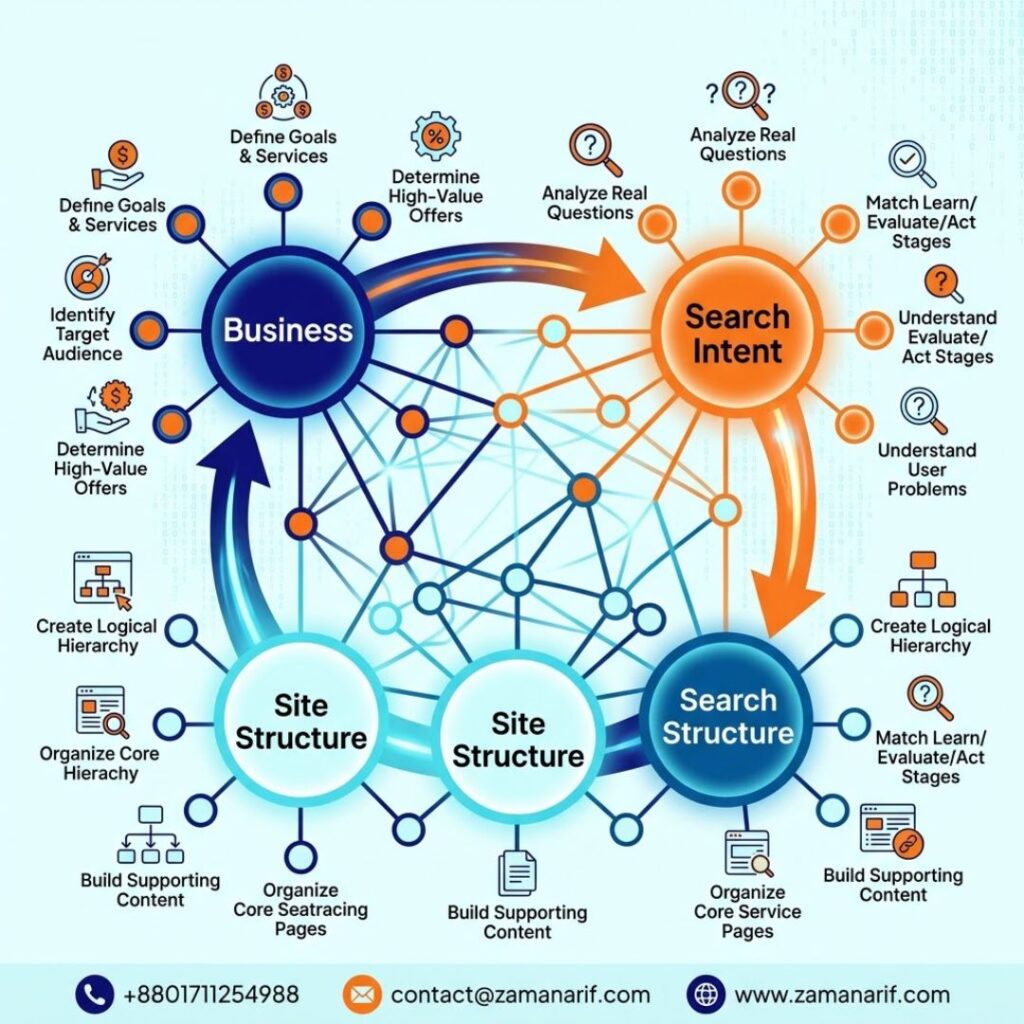
I approach a business website differently. I treat the business model, the search intent behind it, the site structure, the content, the proof behind the claims, the technical foundation, and the path to contact as one connected system, not a stack of separate checklists.
I don’t start by asking what keywords belong on a page. I ask what the business actually sells, who the page is supposed to help, what that person is trying to figure out, what would make the answer believable, and what they should do once they have it. That’s what I mean by a search-ready website.
Being crawlable and indexable is the floor, not the goal. A search-ready site also has to make the business understandable, match real search intent, earn trust, and make the next step obvious. A technically clean site nobody trusts or acts on isn’t search-ready – it’s just efficiently ignored.
I’ve built and fixed websites for tree service, HVAC, roofing, landscaping, and plumbing companies across the US, UK, Canada, and Australia. Nearly every recurring problem traces back to the same root cause: the parts of the site were never designed to talk to each other. I’d rather build a smaller site where every page has a measurable job than a large one full of pages competing for the same traffic.
What “Search-Ready” Actually Covers
A search-ready site spans several layers that most web projects treat as separate silos:
- Business – what the company sells, who it serves, where it operates, and how customers actually decide to buy.
- Search intent – the real questions and comparisons people make before they type a business name into Google.
- Topics and entities – how the services, problems, locations, and related concepts connect.
- Site structure – how pages relate to each other logically, not just what’s in the nav menu.
- Content – pages that answer the question instead of restating it.
- Evidence – what makes a claim believable instead of just asserted.
- Technical foundation – a site that loads fast, works on mobile, and gives search engines and AI tools a clean page to read.
- Conversion – a next step that matches where the visitor actually is.
- Measurement – a way to tell bot traffic from real business outcomes.
None of these work well in isolation. I build them in this order:
Business → search intent → topics and entities → site structure → content and evidence → technical foundation → conversion → measurement.
I’ll change that order when the evidence points to a different bottleneck – if a site’s technical foundation is broken, I fix that before writing another page of content. The sequence is a starting default, not a rulebook.
1. I Start With the Business, Not a Keyword List
Before I open a keyword tool, I want to understand the business behind the site. A local tree service doesn’t sell the same way an emergency HVAC contractor does. A commercial roofer’s customer doesn’t decide the same way a residential landscaping client does. So I start with questions like:
- Who is the business actually trying to serve?
- Which services generate the most valuable, highest-margin work?
- Where does the business genuinely operate?
- What problem does each important service solve?
- What does someone need to understand before they’ll call?
- What real proof can the business offer?
- What should a qualified visitor be able to do once they’re ready to buy?
- What’s already on the site that’s worth keeping, fixing, or cutting?
A keyword with high search volume doesn’t automatically deserve a page. A low-volume, highly specific service can be one of the most valuable pages on the site if it’s the one that pays the bills. A nearby city with plenty of search demand doesn’t deserve a landing page if the business doesn’t work there or has nothing specific to say about that market. Business value comes before page count, every time.
2. I Map Search Intent to the Actual Decision
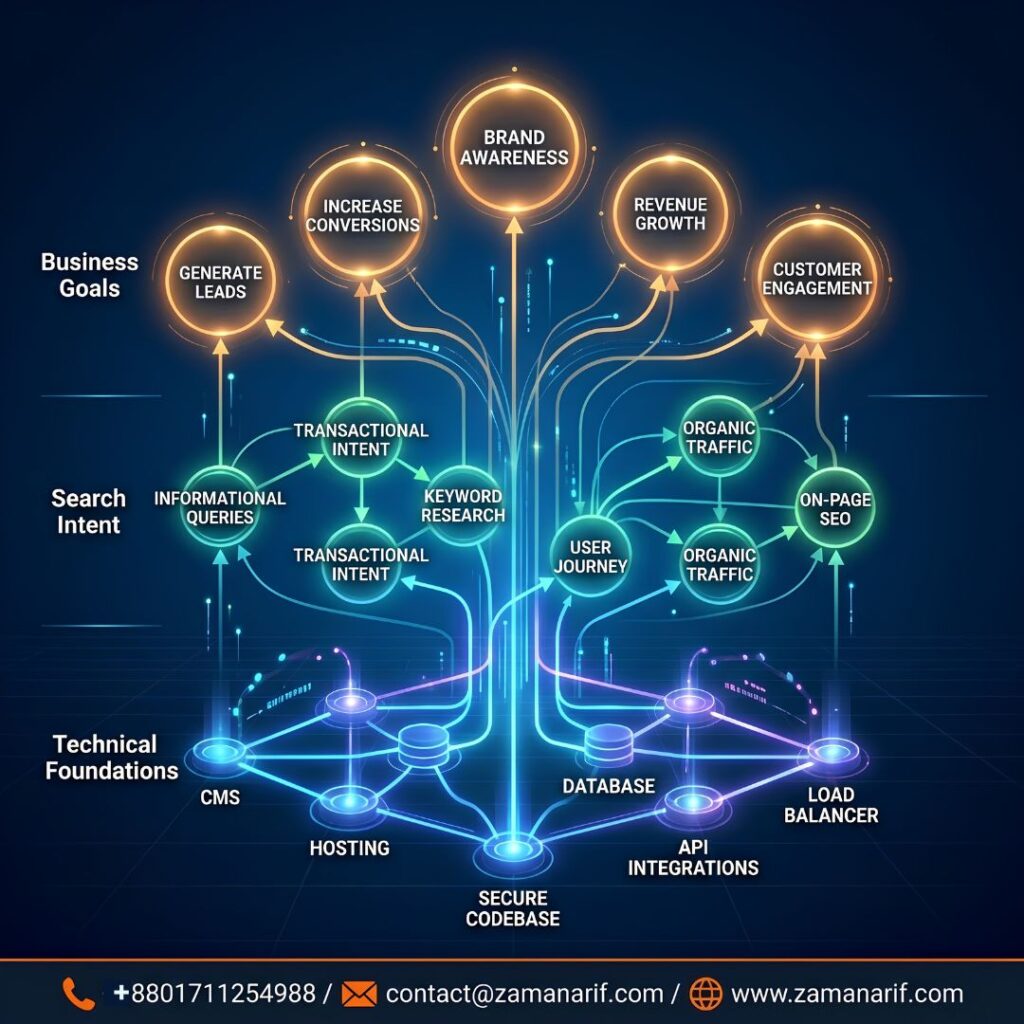
A search query is the surface of a bigger question. “Roof leak” usually means someone is trying to understand a cause. “Roof leak repair near me” means they’re closer to hiring someone. “Roof replacement cost” often means they’re comparing options and bracing for a large expense. Those three searches shouldn’t land on the same type of page.
For every important page, I want clear answers to:
- Who is this page for?
- What are they trying to figure out – learning about a problem, diagnosing an issue, comparing providers, checking a price, or ready to buy?
- What information would actually make that decision easier?
- What should they do once they have it?
I think about the journey in stages – learn, evaluate, compare, decide, act – loosely enough that I don’t force a sales pitch on someone who’s still trying to understand their problem. A diagnostic article explains the problem. A service page explains the solution. A case study supplies evidence. A quote request supports someone ready to act. A blog post that gets traffic but gives the reader nowhere useful to go isn’t doing its job.
Why this still matters when AI answers the question directly
More searches get answered inside AI Overviews before anyone clicks a link. That doesn’t make this approach less relevant – it makes it more relevant. AI systems tend to pull from pages that answer one question clearly, back it with specifics, and don’t just repeat what three other pages on the same site already said. I don’t build separate versions of a page for regular search and AI search – a page built around real intent and real evidence already works for both.
3. I Map Topics and Entities Before I Touch the Site Map
Keywords are a useful input. They aren’t a site structure. Before I decide what URLs need to exist, I map the broader subject – the services, the problems they solve, the audiences involved, the locations that matter, the comparisons people make, the costs, and the alternatives someone might weigh. Then I look at how those pieces relate to each other.
For a roofing company, the map might look like this: roofing connects to roof repair; roof repair connects to leak detection and storm damage; storm damage connects to roof replacement; roof replacement connects to shingle materials, installation cost, and labor warranty – and all of it sits inside a real service area tied to the business entity.
The point isn’t to cram every related phrase onto one page. It’s to figure out which pieces belong together on one page and which represent a different enough question to earn a page of their own. That’s the difference between a site that mentions a lot of topics and one that demonstrably understands how they connect – which is what topical authority actually means.
4. I Build Structure Around Real Relationships
Once I understand the business, the intent, and the topic map, I organize the site around those relationships instead of a flat keyword list. A typical service-business structure includes core service pages at the center, supporting pages that answer diagnostic or comparison questions, location pages tied to real service areas, proof pages (case studies, reviews), and a clear conversion path.
The shape changes project to project. The rule doesn’t: a page exists because it has a distinct, measurable job. A service page explains what the business does. A diagnostic guide explains why the problem is happening. A location page explains how the service is actually delivered in that market. Together they support each other without repeating each other.
5. I Decide Which Pages Actually Deserve to Exist
Page count isn’t the same as authority. Ten location pages with the same paragraph and a swapped city name aren’t ten resources – they’re one idea repeated ten times, and that’s confusing for both visitors and crawlers.
Before I create a page, I ask what specific question it answers, who’s asking it, whether an existing page already answers it, whether the business has something genuinely useful to add, and how it will connect to the rest of the site. If two pages would answer the same question for the same person and point to the same action, I’d rather strengthen one page than split the traffic and authority across two weak ones. “Improve or merge” beats “add another page,” and I default to that even on a site I didn’t build – I want to know what’s already working before I touch it.
6. I Build Real Information Gain Into Every Important Page
A page worth having gives the reader something they couldn’t get from any other page covering the same topic – a decision framework, a real project example, an honest comparison, a limitation worth knowing, or a plain explanation of when the standard advice changes.
Picture a landscaping company with five city pages that each repeat the same three paragraphs about lawn care with the city name swapped. None of them tell a homeowner anything the other four don’t. A stronger version keeps one strong central service page and adds what’s actually different about that market – the soil, the climate, what a typical job in that neighborhood involves, what the company has learned doing the work there for a decade.
That’s the real difference: a keyword page exists to catch a search phrase. A useful page exists to help someone decide. I don’t measure quality in word count – if the honest answer fits in 900 words, I publish 900 words; if the subject needs more, the extra length goes toward solving the reader’s problem, not hitting a target.
7. I Back Every Claim With Something Real
A business website is asking strangers to trust it with their money or their home. Ranking well doesn’t earn that on its own. When a page makes a claim, I want the reader to have a concrete reason to believe it – a description of the actual process, real project examples, credentials that apply to the service, or an honest limitation instead of an inflated promise.
Credibility also includes being clear about what I can’t promise. I can’t guarantee a #1 ranking, a specific number of leads, or a result by a fixed date – competitors shift strategy, demand is seasonal, and algorithms change. What I can control is the quality of the work, the clarity of the content, the technical setup, and how honestly the results get measured. I’d rather say that plainly than promise something I can’t back up.
8. I Treat Internal Links as Relationships, Not Decoration
I don’t add a link because I want a keyword phrase to appear somewhere. Before linking, I ask whether the destination gives the reader context the current page can’t reasonably provide on its own. If yes, the link earns its place. If not, it stays out.
A page about planning a website might lead into a WordPress development page once the reader understands what’s technically involved. A diagnostic guide might lead into the service that solves the problem it just explained. The relationship runs both ways – a core page links out for more detail, and a supporting page links back once the reader is ready to decide.
9. I Handle Local Search Without Doorway Pages
Local relevance matters when geography genuinely changes how a business serves customers, but I won’t build a location page by swapping a city name into the same paragraph. Before a location gets its own page, I check that the business actually serves that area and that there’s real, location-specific information worth including.
Beyond the page itself, local visibility depends on things Google actually checks – a fully completed Google Business Profile, consistent name/address/phone information everywhere it’s listed, accurate LocalBusiness schema, and genuine reviews from customers who live in the area. A well-written local page paired with a thin or inconsistent Business Profile will still underperform. A local page worth having shows real service availability, includes information relevant to that specific market, and provides a clear next step – that’s the line between a real local asset and a doorway page.
10. Development, SEO, Local, and Paid Ads Work Together
WordPress development builds the technical floor – a logical URL structure, templates that hold up under traffic, fast load times, and Core Web Vitals that actually pass on real devices, not just in a lab report. Without that, even strong content underperforms.
Organic SEO earns visibility through useful pages and real semantic relationships between them, not phrases layered on top after the fact. Local search becomes the priority the moment geography affects the buying decision. Paid acquisition – Google Ads, Local Services Ads, Meta Ads – can open faster access to demand, but it still has to point at a real offer and a landing page that answers the question. Paid traffic doesn’t fix a weak offer; it just finds the weakness faster, at a price.
11. I Build the Conversion Path Around Where the Visitor Actually Is
A prominent call-to-action button isn’t a substitute for answering the question first. My usual sequence: answer the question directly, explain the service that solves it, show proof the approach is credible, address the objection the reader is probably still holding, explain what happens next, and then offer the action that fits where they are – a quote request, a consultation, or a call, depending on how that business’s customers actually buy. I don’t reuse the same conversion path across every business, because the buying journey isn’t identical from one to the next.
12. I Measure Business Progress, Not Just Traffic
Traffic is a useful signal, but you can’t deposit pageviews. I’d rather track qualified inquiries, lead quality, booked calls, service-page engagement, search visibility, map pack presence, conversion rate, and paid ad efficiency – through properly configured Google Analytics 4 and Search Console, with the gaps in that data acknowledged rather than glossed over.
I separate leading signals from outcomes. More visibility means a page is easier to find, not that the traffic is qualified. More engagement time describes behavior, not revenue. A qualified inquiry is closer to the real outcome, but even that doesn’t guarantee a closed sale. The goal isn’t one perfect number – it’s a chain of evidence that shows what actually changed and what the data can honestly support.
13. How I Triage a Site That Already Exists
When a business already has an active site, I start by documenting the business model, the highest-value services, the real service area, the current URL structure, and whatever conversion paths already exist – separating what I know from what I’m assuming. Then I map the major visitor questions to the URLs that already exist. If several pages compete to answer the same question, I look at whether combining them produces one stronger page. If an important service has no real page, I figure out what it needs to say before building it.
Then I look at the internal relationships: does the main service page get useful, contextual links? Can someone move naturally from an answer to the service that solves it? Are location pages tied to a real service area? Does the conversion path match where the visitor actually is? Finally, I pick the smallest set of changes that fixes the biggest constraint, and write down the reasoning, the risk, and how we’ll know it worked – so the project stays something we can measure, not an open-ended list of unrelated tasks.
Common Mistakes I Work Hard to Avoid
- Treating site structure as a standalone task. A clean nav menu doesn’t make a site useful on its own – structure has to reflect the business and what visitors need to do.
- Writing for everyone. Broad content turns vague fast. I write for the specific person and the specific decision they’re making.
- Making claims with nothing behind them. A confident sentence isn’t automatically a trustworthy one.
- Asking for the sale before answering the question. Someone still trying to understand their problem isn’t ready for a pitch.
- Changing everything at once. If structure, content, technical settings, and ad spend all change the same week, nobody can tell what caused the result. I’d rather make staged changes I can actually measure.
Who This Approach Is For
This works best for businesses that depend on their website for qualified, high-intent demand – local service businesses, home contractors, professional firms, companies working across more than one service area, and businesses rebuilding an existing WordPress site. It fits businesses investing in long-term organic visibility, or combining organic with paid traffic.
It’s probably not a fit if what you actually want is a guaranteed ranking, a few hundred auto-generated location pages, raw traffic with no regard for lead quality, or a purely visual redesign that ignores whatever search value the current site already has.
What I Can Help You Build
Search-Ready WordPress Development. I build and restructure WordPress sites – including performance-tuned Elementor builds – around search intent, usability, and real-world page speed. Best for businesses that need a stronger technical foundation before anything else will work.
Strategic Organic SEO. Built around business priorities, real search intent, useful content, and how pages connect semantically. Best for businesses that want visibility that holds up over time.
Local Search Domination. For businesses where geography genuinely affects the buying decision – contractors, home-service businesses, and other location-dependent companies.
Data-Driven Performance Marketing. Paid acquisition connected to a real offer, a landing page that answers the question, working conversion tracking, and honest numbers. Best for businesses that need faster access to demand and already have an offer worth promoting.
These can run independently, but they compound when combined, because the structure, the content, and the ad spend are part of the same system.
What Happens When You Reach Out
I don’t want the first conversation to feel like a pitch built around a pre-made package. The first step is understanding what’s actually going on – what the business is trying to do, what the current site is doing well or badly, where the real constraints are, and whether this approach is actually a fit.
If it is, I’ll recommend a scope that matches your goals. If your site doesn’t need a rebuild, I’ll say so. If adding more content isn’t the real problem, I won’t recommend it just because it’s easy to sell. The only goal is fixing the right problem first.
Frequently Asked Questions
What makes a website “search-ready”?
It’s a site where the technical foundation, structure, content, evidence, search intent, and conversion path work together. Being crawlable is necessary but not sufficient – the site also needs to make the business understandable, answer real questions, and make the next step obvious.
Does every service need its own page?
No. A service earns a separate page when it represents a meaningful difference in offer, audience, process, or decision. If two services need nearly identical explanations and lead to the same action, combining them usually produces a stronger page.
How do you tell whether two pages overlap too much?
I compare the audience, the underlying question, and the intended next action. If two pages serve the same person, answer the same question, and point to the same outcome, I look at consolidating them – not to remove depth, but to remove duplication.
Do you build with Elementor or custom code?
Both, depending on the project. For most home-service businesses, a well-optimized Elementor build gives you a fast, editable site without the overhead of a fully custom build – the key is disciplined use, not the tool itself. I strip unused modules, control asset loading, and test Core Web Vitals on real devices rather than accepting default page-builder bloat.
How do you handle schema markup for a service business?
I deploy LocalBusiness, Service, and FAQ schema specific to what the business actually does, rather than relying on a plugin’s automated guesses. The structured data connects your actual business name, services, and location to how search engines and AI tools read the page.
Do I need a location page for every city I want to target?
No. A location page should exist because the business genuinely serves that area and has something specific to say about it. Swapping a city name through an otherwise identical page doesn’t create real local value.
Should I redesign my existing website?
Not automatically. If the current site has valuable rankings, backlinks, or conversion paths, preserving and improving those may be smarter than starting over. I diagnose before recommending a rebuild.
Can SEO guarantee rankings?
No. I can control the strategy, the technical setup, the content, and the measurement – not competitors, shifting demand, or algorithm changes. Anyone promising a guaranteed ranking should be able to explain exactly what they’re guaranteeing and under what conditions.
How does AI search change this approach?
It doesn’t require a separate strategy. Clear answers, real evidence, logical structure, and genuine subject coverage make a page more useful across regular search and AI-generated answers alike. The goal stays the same: make the page genuinely useful and the business genuinely clear.
How long does a rebuild typically take?
Because topical research, content, and technical development happen as one process rather than sequential handoffs, a standard service-business rebuild usually takes 8–12 weeks from discovery call to launch. Rushing it usually means skipping QA on mobile responsiveness or redirects, which shows up as a traffic drop right after launch.
My Take
A search-ready website is part of the business, not a project running next to it. My job isn’t to produce pages or check boxes on an SEO list – it’s to make the structure make sense to the people using it, make the information useful and believable, and make the path from reading to acting obvious.
Good strategy also means restraint. Not every service needs its own page. Not every city needs a landing page. Not every keyword deserves a URL. Not every existing site needs a rebuild. Sometimes the right move is building something new. Sometimes it’s combining what already exists, fixing the technical foundation, or removing pages that never had a real purpose. The important part is knowing which problem actually needs solving.